

Classic cars, like this Porche, can be an expensive hobby; but not all that expensive if you know what to look for.
7 Classic Cars Under $15,000

When classic cars make the headlines it’s usually because one has sold for some outrageous price like the ’57 Ferrari 335 Sport that recently went for a paltry $ 35,711,359 at a Paris auction house. If you’re not into cars that run seven to ten figures a classic can still set you back a big chunk of change with certain models running $30,000 to $800,000 depending on their history and role in the automotive world.
Classic cars can be an expensive hobby; but not all that expensive if you know what to look for. It depends on what you define as classic. If you accept that a classic is an older car with enough historical interest to be collectible and worth preserving or restoring rather than scrapping, then there are a ton of road worthy classics that can be bought for less than $15,000.
A Few Good Classic Car Bets Are out There
A quick check of Hagerty, AutoTrader and others who track trends in the classic car world revealed five undervalued cars and two complete classes of vehicle that qualify as bargains and have the potential to grow in value as interest increases. Here are their suggestions.
1970 – 1973 Datsun 240Z – Japan’s First American Sports Car
The first in a series of models that would result in today’s Nissan 370Z and GT-R, this sporty two door coupe with exciting lines and quick handling had a punch under the hood that outperformed anything from Europe. The 240 (hence 240Z) cdi in-line six generated 151 hp and could do 0 to 60 in 7.8 seconds (faster than a ’70 Porsche 911). The exterior paint jobs were also distinctive and came in shades of red, yellow, green and orange. Originally priced at $3,500 you can find them road ready today for about $15,000.
1965 – 1968 Plymouth Sport Fury / VIP
The Fury was Plymouth’s main sedan and it was big, a bit boxy and occasionally an unintentional muscle car. The base model was really a no frills vehicle and you saw a lot of them doing duty as taxicabs. However, the top trim VIP came as a coupe or convertible and had an interesting array of v8 engine choices including the 440 cid Wedge Engine. In 1965 a Sport Fury paced the Indy 500 driving sales through the roof. According to Hagerty the average price for a Sport Fury in good condition is $13,600.
1972 – 1975 Porsche 914 2.0
This mid-engine roadster with the Targa top was awarded Motor Trend’s Import Car of the Year for 1970. A collaboration (of sorts) between Porsche and Volkswagen, the 914 was created to provide direct competition to the Datsun Z car. Unfortunately negotiations to share tooling costs and let Porsche have exclusive branding rights in the U.S. broke down when the Chairman of VW died and his successor did not honor the verbal agreements of his predecessor. This translated into much higher production costs for Porsche resulting in a retail price just slightly less than a 911. The 914 was a good roadster with incredible handling and comfort (by sport car standards) but it was not a 911 and sales suffered. Today you can own one of these roadsters for between $8,000 and $12,000.
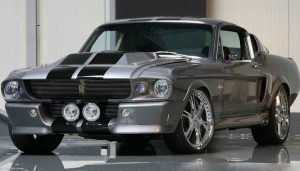
1964 – 1966 Ford Mustang Coupe
That’s right; Ford’s incredibly popular sports car can still be bought for a reasonable price if you know what to look for. The inaugural launch of the Mustang was an instant sales hit because America had not seen an affordable U.S. sports car that looked as cool as the pony and for the first time ordinary families could zip around town it a hot convertible. The early Mustangs were not really performance cars. They were built on Ford Falcon chassis and came with 6 or 8 cylinder engines. There was no comparison performance wise with the Mustangs that rolled off the line from ’67 on. So, a ’64 to 66 coupe in good condition can be had for about $15,500 but you can knock off 25% if the car has a six cylinder engine and another 10% if it has automatic transmission rather than the four speed stick. That gets the price down to $10,000.
1966 Chevrolet Corvair Corsa
Thanks to Ralph Nader the Corvair suffered a serious case of bad press. If the car truly is “unsafe at any speed” as Mr. Nader claims, why are there so many still on the road over 50 years later? In ’65 the Corsa replaced the Spyder as Corvair’s top trim and in ’66 the bathtub design of the body was replaced by smoother lines, a shark type nose and an overall look that challenged Italian and German imports. With a curve-hugging, fully independent suspension, air cooled, turbocharged 164 cubic inch engine and a slug of fun options, the Corsa became and remains a pony car alternative to the Mustang. Hey Jay Leno has one of these! Originally priced at $2,465, a ’66 convertible in good condition can be bought today for about $6,500. The sports coupe is significantly less at $4,000.
Now if you truly believe that a classic car is an older car with enough historical interest to be collectible and worth preserving or restoring rather than scrapping then there are two classes of older cars that may prove to be the next big investment bargain:
1967 – 1975 Convertibles and 1965 – 1985 Pickup Trucks
The American interest in trucks is not surprising; trucks are the number one body sold in the U.S. It’s just a matter of time before there is a boom in trucks of the past and why not. Who can resist a 1967 Ford Ranger F100 short bed with its huge chrome grill, two tone paint job and 8-cyl. 352cid/208hp 2bbl engine? Today in good condition it goes for $9,900.
Then there are the 60s and 70s ragtops whose retro looks are always in demand for 4th of July Parades but little else. Smart money says that is going to change (global warming benefit?) and those big chrome grills, stacked headlights, long rigid lines will be in demand again. The 1970 Chevrolet Impala with the top down can accommodate the entire homecoming court. It’s big but underpowered with a 6-cyl. 250cid/155hp 1bbl engine. On the plus side, you can get one for a bit over $8,000.
Of course classics demand attention and if you are not an enthusiast this is probably not a hobby for you. There are always concerns about parts and trim and the availability of a mechanic, or at least guide, that knows how to work on the things. If you have an eye on a specific model, you may want to check and see if there is a fan club in your area. If there is make sure you hook up with these guys and gals so you can get the best deal possible.


