
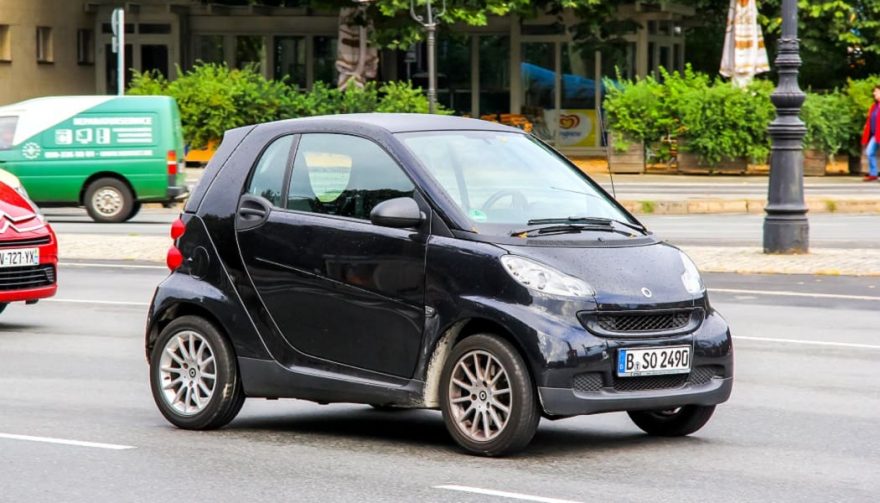
Auf Wiedersehen gas-powered Smart car.
Gas-Powered Smart Car Getting the Axe, Electric Continues

After the 2017 model year, the gas-powered Smart Fortwo will no longer be available for purchase in the United States or Canada. The announcement from Mercedes-Benz comes as gas prices have remained steady, prompting car buyers to trend into dangerous gas-guzzler territory once again.
Smart will continue to offer the electric version of the microcar in the future. In fact, the electric car will receive vigorous attention from Mercedes, expecting the tiny two-seater to play an important part in future electric car development.
The Smart Evolution
You might remember the gas-powered Smart car bursting onto the North American scene in 2008. The minuscule car arrived with pomp and circumstance, even dredging up 30,000 pre-orders.
But since then, it’s been a downward spiral as the Smart Fortwo has been stagnant. If you look at today’s Smart car compared to the first incarnation, there’s not much difference in design.
Initial models used the 1.0-liter gas three-cylinder with only 70 horsepower. Despite having a smaller engine than many motorcycles, the Smart Fortwo didn’t achieve great economy. It was rated at just 33 miles per gallon.
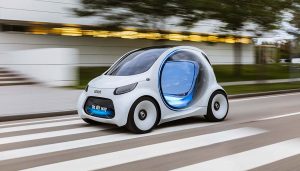
In 2009, the electric version reached San Diego through Car2Go. With an impressive 104 mpg-equivalent rating, the Smart car became relevant once again. For the 2018 model year and onward, the Smart Fortwo will strictly be an electric car series.
In its third generation, the Smart Fortwo showcases Mercedes’ commitment to alternative fuels and electric vehicle technology.
Why the Smart Car Matters
In 2016, barely more than 6,000 Smart Fortwo models hit U.S. streets. It’s hardly worthy of mentioning on its own, but consider this: the electric-powered Fortwo uses EV batteries supplied by Tesla.
Mercedes-Benz plans to unveil two electric sport utility vehicles and two sedans soon. CAFÉ standards are becoming more restrictive than ever for fuel economy. And, electric cars are more popular and accepted than ever. An electric car, the Chevrolet Bolt, even won the Car of the Year award for 2017.
Mercedes-Benz is likely to find themselves out of touch with customer needs without the electric Smart Fortwo, even if it’s just an iconic car. Through a shift in focus, they are able to use the Smart Fortwo as a pawn in the attempt to make Mercedes-Benz a household name.


